How to Beat a 4-3-3 Formation: 5 Tactical Strategies That Work
April 28 2010, a day Barcelona fans would never forget, it feels like it was just yesterday. It was the second leg of the Champions League semi-final between Barcelona and Inter Milan. Milan has won the first leg at home 3-1 about a week earlier. Now at Camp Nou Barcelona had Messi, Ibrahimovic, Xavi and other big stars. The possessed the ball for most part of the match mostly because Milan were down to ten men after a red card was issued to Thiago Motta.
Despite playing with 10 men for over an hour, José Mourinho’s side executed a legendary defensive masterclass to hold Pep Guardiola‘s Barcelona to a 1–0 win, Inter progressed to the Finals with 3–2 win on aggregate.
Mourinho’s side didn’t win by trying to win the ball and dominate possession against Gaurdiola’s famous 4-3-3 Tiki Taka system instead they focused on neutralizing its strengths and exploiting its fatal structural flaws. They knew where the gaps were, where to stand, and when to attack aggressively. That’s the whole secret, and it’s the essence of this article.
Beating a 4-3-3 isn’t really about having better players , although that makes it a lot easier. It’s about making the shape work against itself. Below, I’ll walk you through how to beat a 4-3-3 formation using five strategies you can spot in real matches. Whether you coach a high school team, analyze football matches for fun or whatsoever, or size up a match before putting money on it, you’ll find something useful here.
Key Takeaways
1. Punish the full-backs. They push high, so the channel behind them is the quickest route to goal. Go early, before the winger tracks back.
2. Win the middle with numbers. A 4-4-2, 4-2-3-1 or 3-5-2 gives you an extra body against their midfield three.
3. Block the number 6. Cut the pass to their holding midfielder with a cover shadow and the whole team struggles to build.
4. Find the half-spaces. The lanes between the wing and the centre are where nobody clearly owns the ball.
5. Counter fast, with company. Make the first pass forward and clean, and send at least three players after it.
What Is a 4-3-3 Formation?
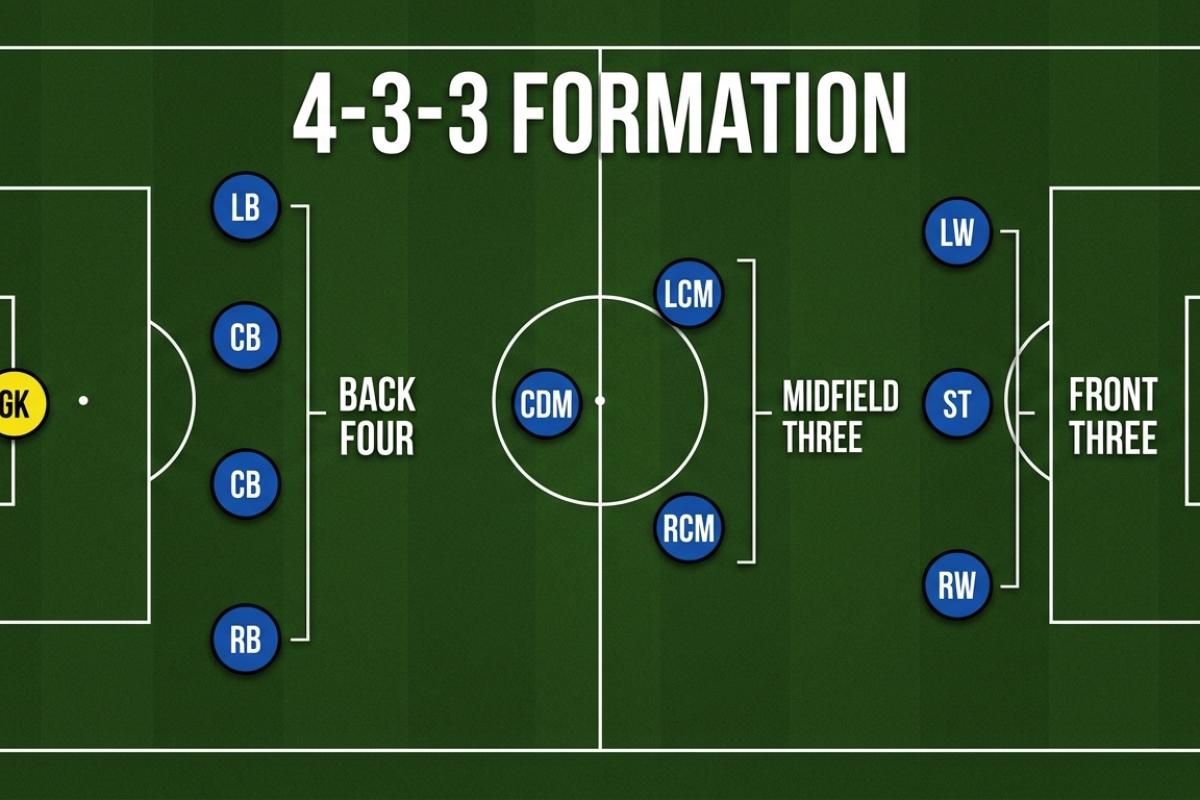
The 4-3-3 formation is four defenders, three midfielders and three forwards. Simple right? But it’s popular for a good number of reasons:
It gives width. Two wingers stretch the pitch, so you can’t squeeze everyone into the middle.
It gives balance. The midfield trio forms a triangle, which makes short passing easy.
It supports a high press. Three forwards can harass your back line from the first whistle.
Pep Guardiola’s Barcelona made the 4-3-3 formation famous. Jürgen Klopp’s Liverpool took it to the 2019 Champions League and made it loud. Luciano Spalletti’s Napoli used it to win the 2022-23 season of the Italian Serie A.
However, treating every 4-3-3 as the same is where most online guides get it wrong because its isn’t. The key to beating a 4-3-3 formation is to spend the first 10 minutes of the match working out and understanding which one you are up against.
Types of 4-3-3 Formations
|
Type |
What you’ll see |
Classic example |
Strategies that work best |
|
Possession-based |
Slow build-up, full-backs tucking in or pushing high, lots of short passes |
Guardiola’s Barcelona |
#2, #3, #5 |
|
Pressing-based |
Aggressive high press, quick ball wins, wingers pinning your full-backs |
Klopp’s Liverpool |
#1, #5 |
|
Direct and vertical |
Quick forward passes, wingers cutting in, fewer passes per attack |
Many strong mid-table sides |
#3, #4 |
Weaknesses of the 4-3-3 Formation
The 4-3-3 formation is widely celebrated as the ultimate blueprint for fluid, possession-based attacking football. By naturally creating passing triangles across the pitch and offering maximum width, it allows dominant teams to suffocate opponents in their own half. However, this high-reward structure inherently demands immense risk. When a 4-3-3 meets a tactically disciplined opponent, its structural elegance can quickly transform into a liability.
The system's greatest strengths are directly tied to its most fatal vulnerabilities and every strategy discussed in this article targets these vulnerabilities.
|
Area |
Why it’s a weak spot |
What you can do |
|
Space behind the full-backs |
Full-backs push high to support the wingers |
Fast counters down the flanks |
|
Gaps between the three midfielders |
Three players can’t cover the full width |
Pass into the half-spaces |
|
The lone holding midfielder |
One player carries a huge workload |
Block him and the shape wobbles |
|
Transition moments |
When they lose the ball, they’re stretched |
Quick, direct attacks |
5 Strategies to Attack the 4-3-3 Formation
You've seen where the 4-3-3 is weak. Now its time to get to the heart of this article: how to actually hit those weak spots.
The five strategies below work as a toolkit, not a checklist. You won't and shouldn’t try to use all of them in one match. Pick the two or three that suit the strength and abilities of your players and the type of 4-3-3 you're facing then commit to them.
We'll start with the one that’s easy and quick to set up, hard to defend, and it works against almost every version of the 4-3-3 formation.
1. Attack the Space Behind the Full-Backs
If I could only dish out one strategy, believe me, it would be this one. That’s solely because in the 4-3-3 formation full-backs are meant to bomb forward. But every time they do that, they leave a wide, empty lane behind them, and the centre-backs have to cover it.
That gap between the full-back and the centre-back is called the channel. Your job as a coach is to quickly find it and try to exploit it.
How to do it
Play a runner. You want a forward or winger who treats a through ball like a starting pistol. Leicester City’s title-winning side of the 2015–16 season was built around exactly this strategy. They stayed compacted and whenever they win the ball, Jamie Vardy is quickly sent into the channel.
Go early. The gap exists for just a few seconds then the winger tracks back. If you wait a few seconds it’s gone.
Curve your run. A runner who starts from the side of the defender and bends in stays onside and is harder to track.
Make the full-back choose. Push your winger out wide, right up against the touchline. Now the full-back has a problem. If he follows your winger, he drifts away from his centre-back and opens the channel for your runner. If he stays tucked in to guard it, your winger gets time and space out wide. Either way, you get something.
2. Outnumber Their Midfield
Loot at as a bit of simple maths, four players against three? The four will often win.
The 4-3-3 formation puts too many responsibilities on its three midfielders. They have to assist the defenders, link play, press and also support the attack. As a coach all you need to do is add one extra body in the middle and suddenly each of those jobs gets harder to carry out
|
Your formation |
Midfield numbers |
Why it works against a 4-3-3 |
|
4-4-2 (flat) |
4 v 3 |
Extra body in the middle, plus two strikers who pin their centre-backs |
|
4-4-2 diamond |
4 v 3 |
The diamond crowds the centre and blocks the passing triangle |
|
4-2-3-1 |
5 v 3 when wide players tuck in |
Swarm the middle but still keep width |
|
3-5-2 |
5 v 3 |
Wing-backs give width, the central three of five stay compact |
The idea behind this strategy isn’t to copy their shape or formation. It’s to customize yours so you have more players where the game is mostly decided.
A good example is Diego Simeone’s Atlético Madrid, who won La Liga in 2013–14 with a tight 4-4-2. Two banks of four, very little space between the lines, and a lot of grit. They clinched the title with a draw at Barcelona on the final day. It wasn’t glamorous, but it worked out very well for them.
Common mistake
Extra numbers don’t help if the players are not up and moving. You need to stay close, rotate and jump on loose balls.
3. Squeeze the Holding Midfielder
In most 4-3-3 setups, one player sits at the base of the midfield. Call him the number 6, the anchor or the pivot. He takes the ball from the centre-backs and decides where it goes next from that position.
So here’s the catch, if you take him out of the game, the whole team often becomes unorganized and lost.
Think of him as the cashier at a busy supermarket. If the cashier is stuck or probably struggling with her computer, the customer queue becomes very long and most of time quickly become agitated.
Three ways to shut him down
Use a cover shadow. Position a striker so the centre-back’s pass to him is intercepted before it gets to him. The ball should rather go wide instead, which is much easier to defend.
Man-mark him with an attacker. Give one forward or attacking midfielder the job of staying glued to him. It’s annoying work, but it can be decisive at the long run.
Trap him against the touchline. If he drifts wide to get the ball, close him down with two players and win it in a dangerous area.
Watch out for the drop
Smart 4-3-3 formation teams will drop the number 6 between the two centre-backs to escape your marker, don’t chase him all the way back. Stay in your shape, let them have the ball in their own half and your aim at this point is to intercept their next pass. You’ll need a little patience to win in this strategy.
4. Use the Half-Spaces
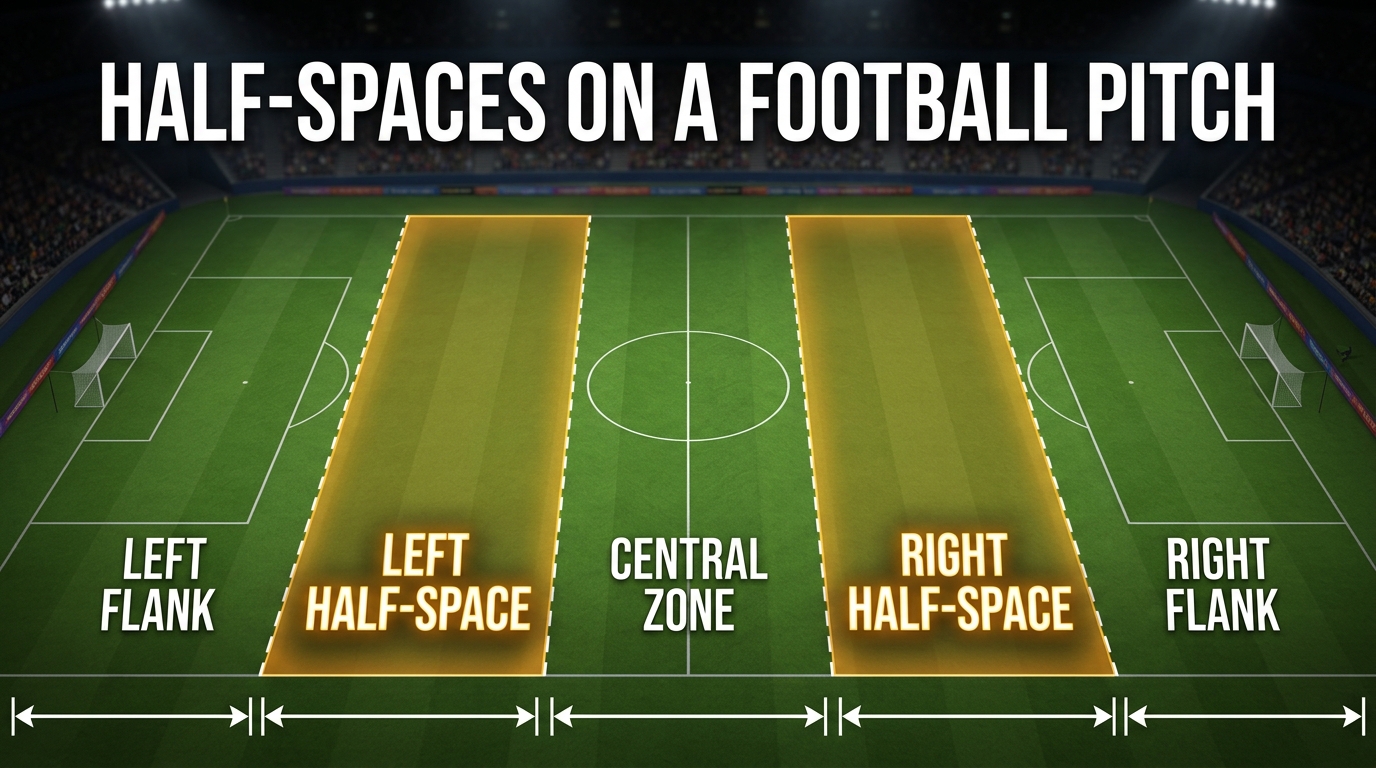
The concept sounds complicated, but the principle is fairly simple. Divide the pitch into five vertical channels: two wide areas, one central corridor and two channels in between. Those two intermediate channels are what we call the half-spaces.
Their tactical importance becomes clearer when you consider how a 4-3-3 is structured defensively. The wide players are expected to protect the flanks, while the midfield three occupy and defend the central areas. The half-spaces sit right between those responsibilities, creating an uncomfortable dilemma for the opposition.
When an attacker receives possession in these areas, the defensive structure is forced into making a decision. Does the full-back step inside and leave space out wide or does the central midfielder move across and risk opening up the middle?
That split-second uncertainty is precisely what you the attacking teams look to exploit. A player receiving between the lines in the half-space has the freedom to turn, drive at the defence, combine with teammates or thread a pass into the penalty area.
In modern football, controlling these spaces can be the difference between simply keeping possession and creating genuine goalscoring opportunities.
|
Lane |
Who guards it in a 4-g3-3 |
Risk for them |
|
Wide (left and right) |
Full-back and winger |
Medium |
|
Half-space (left and right) |
Nobody clearly |
High |
|
Centre |
Midfield trio and centre-backs |
Medium |
How to attack them
Put an attacking midfielder or inside forward in the half-space. He receives the ball on the half-turn and runs at the defence.
Drag a defender out of position first. Stretch your winger wide so the full-back follows, then slip the pass into the gap he left.
Combine quickly. One-twos and third-man runs are brilliant here because defenders can’t decide who to follow.
The way I describe this to myself so I remember easily is: don’t try to knock on the front door or the back door, climb in through the window.
Common mistake
Receiving the ball and then standing or being sloppy. If you pause or waste a few seconds the midfield trio will close you down.
5. Win the Transition Battle
This is the the ultimate jackpot strategy. This is the tactical advantage responsible for many unexpected results in football.
A 4-3-3 that attacks well pushes players high. That’s great when team is possession of the ball. But the second it loses it, there’s a gap between the defence and the midfield and a bigger gap behind everyone. That’s your window or opening to unleash terror and punish them.
There’s one pushback though, many 4-3-3 teams counter-press. They try to win the ball back within a few seconds of losing it. So your first pass after you win the ball matters most. Push it forward, make it clean and quickly get out of the press zone before it closes you down.
The counter-attack checklist
Stay compact when defending. Keep your lines tight so there’s nothing to play through.
Know your first pass. The moment you win the ball, someone should already know where it’s going. Usually it’s forward and fast.
Send at least three players forward. A lone runner gets swallowed up. A group of three makes defenders panic.
- Don’t slow it down. If the break is on, don’t “keep possession” for the sake of it.
That Inter Milan side in the Champions League 2010 is the case study for this strategy. They defended deep and disciplined, and when they won it, they hit Barcelona on the break. The huge lesson here is that winning ball possession is not the same as winning the game.
Common mistake
Counter-attacking with too few players or too many sideways passes. The attack needs to be precise and quick.
Putting It All Together
You don’t have to pick just one. The best teams mix two or three of these strategies. Here’s a quick cheat sheet.
|
If your team is… |
Best approach |
Lean on |
|
Fast but outmatched on the ball |
Defend deep, counter hard |
#1 and #5 |
|
Strong and hard-working in midfield |
Overload the centre |
#2 and #3 |
|
Technical and good with short passes |
Find gaps between the lines |
#4 |
|
Well-organised but short on stars |
Stay compact, break quickly |
#2 and #5 |
How a 4-4-2 might set up against a 4-3-3:
Start compact. Two banks of four, close together.
Use a striker to block the number 6. Cut the easy pass.
Win it, then go. First pass forward, second into the channel.
Let wide midfielders tuck in. They receive in the half-spaces.
Be patient. You won’t get a chance every minute. Wait for the right moments.
Mistakes That Cost Games
Copying their shape. Mirroring a 4-3-3 gives them a fair fight. You want an unfair one.
Pressing too high with a slow back line. The channels open and you pay for it.
Ignoring the wingers. If they’re isolated one-on-one with your full-back, you’re in trouble.
Chasing the ball. Staying compact and making them pass into traffic is smarter than sprinting around.
For Analysts and Bettors
If you’re sizing up a game, check team news first. A missing full-back, a suspended holding midfielder, or a slow centre-back can swing the tactical picture a lot. If the 4-3-3 side is missing the pivot, strategies #3 and #5 suddenly look a lot more dangerous for them.
That said, no tactic is a guarantee. Football is chaotic, which is why we love it. If you bet, do it responsibly and only with money you can afford to lose.
Frequently Asked Questions
What is the best formation to beat a 4-3-3?
There’s no single answer, but the 4-4-2 (flat or diamond), the 4-2-3-1 and the 3-5-2 are popular choices. They give you extra numbers in midfield, which is where a 4-3-3 can be stretched. A fast side might prefer a 4-4-2, while a more technical team may like a 4-2-3-1.
What are the weaknesses of a 4-3-3?
The main ones are the space behind the full-backs, the gaps between the midfielders, pressure on a lone holding midfielder, and the risk of being caught on the counter. A good plan targets one or two of these rather than all four.
Is a 4-3-3 better than a 4-4-2?
Neither is better in every case. A 4-3-3 gives you width and a strong press. A 4-4-2 gives you compactness and numbers in the middle. Both have won major trophies, as the Atlético and Barcelona examples above show.
How do you defend against wingers in a 4-3-3?
Keep your full-back close, but make sure a nearby midfielder can help so he’s never isolated. Show the winger onto his weaker foot and avoid diving in. Staying on your feet is usually smarter.
Should I play a high line or a low block against a 4-3-3?
It depends on your players. A low block suits quick forwards and a patient team. A high line suits good pressers and a fast back four. Just don’t play a high line with slow centre-backs.
Final Thought
The best way to beat the 4-3-3 formation is for you to find the soft spots, win the ball and hit them fast and clean. To do that you need to run behind the full-backs, outnumber the midfield, squeeze the number 6 and use the half-spaces.
None of this is rocket science. It takes practice, patience and a bit of nerve. But a team with a plan will usually beat a team with a reputation.
Now I’d love to hear from you. Have you coached, played or watched a team beat a 4-3-3 in a clever way? Drop it in the comments, share this guide with your teammates or group chat, and let’s keep the tactics talk going.
Albert Akpama (Albertflex) is a tech guru, football enthusiast and sports writer that’s passionate about making football predictions easier to understand. He focuses on match analysis, prediction strategies, bookmaker reviews and betting insights, helping readers understand the key factors that influence football match results. At 1Banter, Albert combines his passion for football with a practical, evidence-based approach to analysing matches.
All author postsRelated posts
-
How to Become a Professional Footballer: A Step-by-Step Guide
Want to become a professional footballer? Learn the key steps,...
-
What Is a Counter-Attack in Football? Meaning, Tactics and Examples
Discover what makes a successful counter-attacking team, from...
-
What Is a Brace and Hat-Trick in Football? Key Differences Explained
Brace and hat-trick in football explained: what each term mean...



0 Comments
- No comments yet. Be the first to share your thoughts.
Login to post a comment.